
How to Do SEO

Many people ask me about how to do SEO and I know they are not referring to theory. They are asking for clear guidance. Most of the SEO guides make things confusing than they need to be. They mention tools, algorithms, and rankings.
SEO is easy if you know one thing that Google wants to display the best answer to the question. Your job is to be that answer.
This guide to How to do SEO is written in simple terms, from real-world experience and official advice.
What Is SEO?

SEO stands for improving your website’s visibility so that it can show higher on Google when people search related to your business or content.
That is all SEO is.
Google checks your page and asks:
- Does this page answer the question?
- Is it easy to read and use?
- Can this website be trusted?
If so, your chances improve.
According to official advice from Google Search Central, Google favors content written for users, not content written to rank.
How to Do SEO for My Website?
If you are wondering how to do SEO for my website, do not begin by writing blog posts right away. First, learn about your website.
Ask yourself:
- What is the aim/goal of this website?
- Who is it for?
- What problem does it solve?
If your website is not clear, Google will not understand it either. The best SEO is when your website has one purpose and content that supports it.
How to Do SEO Keyword Research.

Keyword research is the process of discovering what people search for on Google.
Many new SEO marketers believe this is all about using tools, but that’s not true.
I always begin with Google itself. When someone searches for any keyword on Google, for example, “How to do SEO” it gives them suggestions. These suggestions come from actual searches. The “People Also Ask” area gives you actual questions that people have.
It shows what people really want and how they usually search for it in their own words.
Ahrefs or Semrush can slightly help, but you should never fully depend on them.
The biggest mistake is using keywords based on search volume alone. If the keyword does not refer to what your page is about, it will not rank.
Content That Works for SEO
The best SEO content is natural. It should sound like a human talking, not a machine trying to rank.
When a person looks for ways to perform SEO, they are looking for understanding and assurance. They do not want complex sentences or technical terms.
I focus on the following:
- One topic per page
- Naturally using keywords in sentences
- Concept explanation in a step-by-step process
- Using short and simple paragraphs
If a sentence is not good enough, I remove it. Google can recognize content created only for keywords.
What to Do and What Not to Do in SEO
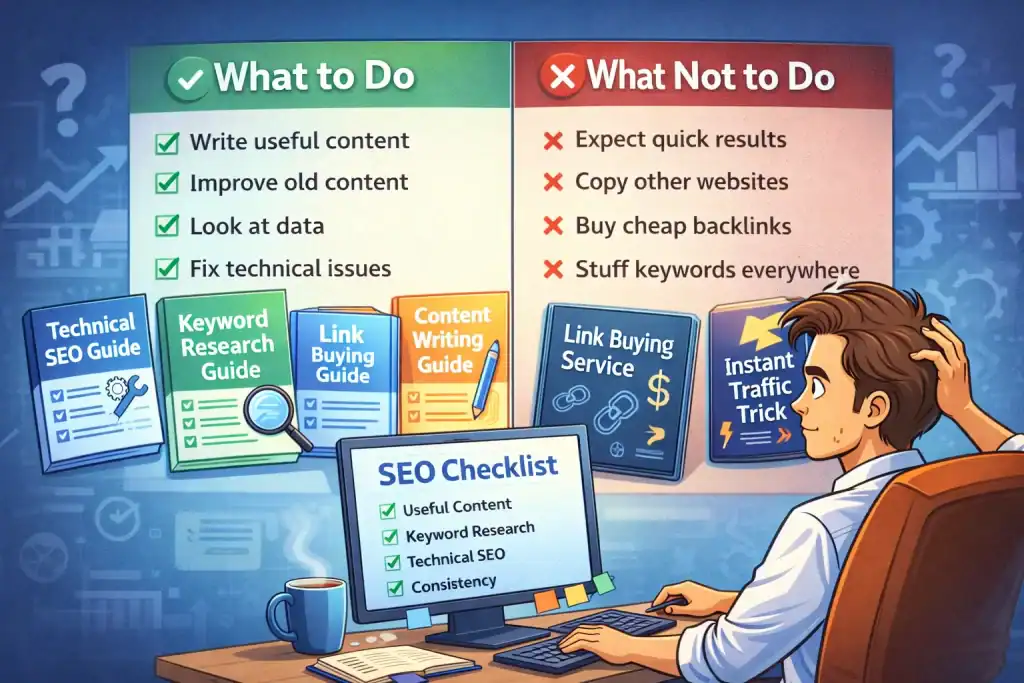
There are a lot of conceptions on SEO, but basic fundamentals remain the same.
You should focus on making useful content, optimizing your current pages, and analyzing your data with the help of Google Search Console. You should also ensure that your website is mobile-friendly and loads quickly.
You should not concentrate on quick success, copying information from other websites, keyword stuffing, or purchasing backlinks. These strategies may help you in the short run, but they might create problems for you in the long run.
SEO is a game of patience, but it is consistent if you do it correctly.
Technical SEO

You do not have to be a programmer to perform SEO, but your site has to be working properly.
Your site has to load fast, be mobile-friendly, use HTTPS, and enable Google to index high-priority pages. If your visitors have problems navigating your site, Google will be aware of that.
Google has been very clear that page experience and usability are important for search engine visibility.
Trust and E-E-A-T
Google wants to display the results of people who know what they are talking about.
This is where Experience, Expertise, Authority, and Trust helps.
You earn trust by sharing your experience, being truthful, updating your content, and using credible sources when necessary. You don’t have to say you are an expert. You just have to be truthful and consistent.
The Truth About SEO
SEO can be frustrating. That’s why this article will help you on How to do SEO.
You write content and see no traffic for weeks or months. This doesn’t mean your content is bad. This means Google is testing your content.
90% people give up too soon. Those who work consistently are the ones who succeed.
Submit Your Story
If you’ve tried SEO but failed, your story matters. People will know a proper way of How to do SEO
If you’ve learned anything from your own website, even a little improvement, share your story. Your experiences are more valuable than tips.
Frequently Asked Questions (FAQs)
How long does it take for SEO to show results?
SEO usually takes a few months to show results. It mostly depends on competition, quality, and website health.
Do I need paid SEO software?
No. Google Search Console, Google Search, and common sense are all you need to get started.
Is SEO still relevant?
Yes. SEO provides long-term traffic and doesn’t stop like paid ads.
Will AI-written content rank on Google?
AI can help, but the content must be checked, edited, and optimized by a human. Google favors helpful, human-made content.
How This Article Was Created
This article is based on:
- Google’s official SEO and Helpful Content guidelines
- Public documentation from Google Search Central
- Real-world SEO experience
- Trusted industry best practices
No fake statistics. No unverified claims. Everything aligns with how Google evaluates content today.
I hope this article, “How to do SEO”, helped you understand the basic fundamentals of SEO. You can also check out my workflow on my homepage. You can also contact me through mail.
References
- Google Search Central – SEO Starter Guide
https://developers.google.com/search/docs/fundamentals/seo-starter-guide - Google Search Essentials (Core policies for pages and indexing)
https://developers.google.com/search/docs/essentials - Helpful Content Update Announcement (Official Google Blog)
https://blog.google/products-and-platforms/products/search/more-content-by-people-for-people-in-search/
Leave a Comment